

Evolution of Manufacturing and Service Industry
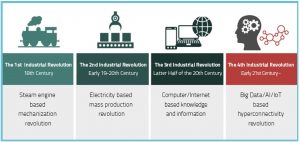
Throughout the history of mankind global business and administration institutes had to go through several transitions. During these transitions companies or organizations that has managed to learn, develop, and adopt their three Ps (People, Process & Product) to match the demands of new normal has thrived. Of Couse, the transitions happened due to varies reasons.
* In the first industrial revolution it was the introduction of mechanization and using coal to power steam engines.
* In the second industrial revolution the emergence of new source of energy electricity, gas and oil created massive technological advancement. As a result, the creation of internal combustion engine, development of steal demand, chemical synthesis, telegraph and telephone and invention of the automobile, plane changed the way people, processes and products were interacting.
* The third revolution brought the rise of electronics, telecommunication and of cause computers. It opened the doors to space expeditions, research, biotechnology, programmable logic controls and robots which helped to rise to an era of high-level automation.
* In the fourth industrial revolution advances in artificial intelligence, robotics, internet of things, 3D printing, genetic engineering, quantum computing is changing and challenging the way we create our products and services.
Apart from these industrial revolutions, the availability of raw material, machineries, geographical locations, human resources, demand of quality and competition has constantly and continuously challenged the survival of business and administrative institutions.
Along with these challenges mankind had to find new ways to manage things. Thus, the evolution of management thoughts and theories also took place. Companies around the world have adopted these theories and used their knowledge, experience to develop breakthrough operating systems that resulted in breakthrough improvements. Toyota Production system is one of those world-class operating systems that later popularized as Lean Manufacturing System.