

Beyond the Tools: Why People and Culture are the True Engines of Lean Success
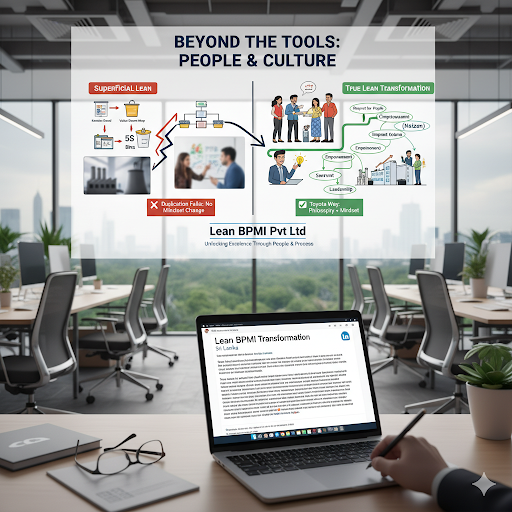
Beyond the Tools: Why People and Culture are the True Engines of Lean Success
For decades, companies worldwide have sought to emulate the phenomenal success of Toyota, a company synonymous with Lean manufacturing and operational excellence. Many have diligently adopted tools like Kanban, 5S, and Value Stream Mapping, only to find their Lean initiatives stall or fail to deliver the expected transformative results. Why the disconnect? The answer lies in a fundamental misunderstanding: Lean is not merely a collection of tools; it’s a deeply ingrained philosophy, a mindset, and above all, a people and culture development strategy.
Here at Lean BPMI Pvt Ltd, Sri Lanka, we’ve seen firsthand that truly successful Lean implementation hinges on understanding the profound differences in how Toyota built its system, particularly compared to how many other organizations attempt to “duplicate” it.
The Toyota Difference: A Foundation of Philosophy, Not Just Process
When companies attempt to replicate Toyota’s success, they often focus on the visible manifestations of the Toyota Production System (TPS) – the techniques and practices. However, what they often miss is the invisible, yet immensely powerful, bedrock upon which TPS was built: the Toyota Way philosophy.
This philosophy, deeply rooted in principles like respect for people and continuous improvement (Kaizen), fosters a culture where every employee is empowered to identify problems, suggest solutions, and actively participate in improving processes. It’s a system where:
- Problem-solving is everyone’s responsibility: Not just for engineers or managers, but for every single team member on the shop floor.
- Trust and psychological safety are paramount: Employees feel safe to voice concerns, experiment, and even make mistakes, knowing it’s part of the learning process.
- Long-term thinking trumps short-term gains: Decisions are made with sustainability and continuous improvement in mind, rather than quick fixes.
- Humility and self-reflection are encouraged: Leaders and team members alike are constantly questioning the status quo and seeking better ways.
The Evolution of TPS and the Lean Mindset
The Toyota Production System didn’t appear overnight as a fully formed methodology. It evolved over decades, driven by a relentless pursuit of efficiency and quality, deeply embedded in the company’s DNA. This evolution was inextricably linked to the development of a “Lean mindset” throughout the organization.
Consider these key elements:
- Respect for People (Jidoka & Just-in-Time): While Jidoka (automation with a human touch) and Just-in-Time (producing only what is needed, when it is needed) are often seen as technical aspects of TPS, their underlying principle is a profound respect for human intelligence and effort. Jidoka empowers workers to stop production lines when abnormalities occur, preventing defects and ensuring quality. Just-in-Time eliminates waste, making work more focused and less stressful. Both demonstrate a deep trust in the capabilities of the workforce.
- Continuous Improvement (Kaizen): Kaizen isn’t just a suggestion box; it’s a way of life at Toyota. It’s a continuous, incremental improvement process driven by everyone, every day. This culture of relentless learning and adaptation fosters a dynamic environment where processes are constantly refined, and problems are seen as opportunities for growth.
- Leadership as Coaches and Mentors: Toyota leaders don’t just dictate tasks; they coach, mentor, and empower their teams. They spend time on the gemba (the actual place where work happens), observing, asking questions, and guiding their teams to solve problems themselves. This builds capability and ownership throughout the organization.
Why Duplication Fails: The Cultural Chasm
Many companies trying to “do Lean” often fall into the trap of superficial imitation. They adopt the tools without embracing the underlying philosophy and cultural shifts. They might implement a Kanban board, but without the cultural commitment to flow, problem-solving, and continuous improvement, it becomes just another visual aid, not a driver of change.
The differences are stark:
- External Focus vs. Internal Transformation: Many companies view Lean as an external “project” to be implemented, often with a start and an end date. Toyota views it as an ongoing internal transformation, a continuous journey embedded in their daily operations.
- Top-Down Mandate vs. Bottom-Up Empowerment: While management support is crucial, true Lean thrives on bottom-up empowerment. If employees aren’t given the autonomy and training to identify and solve problems, Lean initiatives will remain a top-down mandate with limited impact.
- Blame Culture vs. Learning Culture: In many organizations, mistakes are met with blame. In a true Lean culture, mistakes are seen as learning opportunities, prompts for root cause analysis, and a chance to improve processes.
Building Your Own Lean Culture: A Roadmap for Success
For organizations in Sri Lanka and beyond, truly leveraging Lean means going beyond the technical aspects. It requires a deliberate and sustained effort to cultivate a Lean mindset and culture.
Here’s how Lean BPMI Pvt Ltd can help you embark on this transformative journey:
- Leadership Buy-in and Commitment: Lean transformation must start at the top. Leaders need to understand, champion, and visibly commit to the Lean philosophy, not just the tools.
- Education and Awareness: Provide comprehensive training that goes beyond the “how-to” of tools and delves into the “why” behind Lean principles and the Toyota Way.
- Empowerment and Engagement: Create platforms and processes that empower every employee to participate in problem-solving and continuous improvement. Encourage experimentation and learning.
- Develop a Learning Culture: Foster an environment where mistakes are viewed as learning opportunities, and continuous improvement is celebrated.
- Gemba Walks and Coaching: Encourage leaders and managers to regularly spend time on the shop floor, observing processes, asking questions, and coaching their teams.
- Patience and Persistence: Building a Lean culture is a long-term endeavor. It requires patience, persistence, and a commitment to continuous effort.
At Lean BPMI Pvt Ltd, we believe that true Lean success isn’t about perfectly copying Toyota’s system, but about understanding its underlying philosophy and adapting it to your unique organizational context, always with a strong emphasis on your most valuable asset: your people.
Let’s work together to build a sustainable culture of excellence.
Sajith Abeyrathne
CLSSBB (US), LMBB (US), MBA (UK), MBA (IND), TPM (JAPAN), GSD (UK)