

Lean Before Toyota: The Global DNA of Modern Efficiency
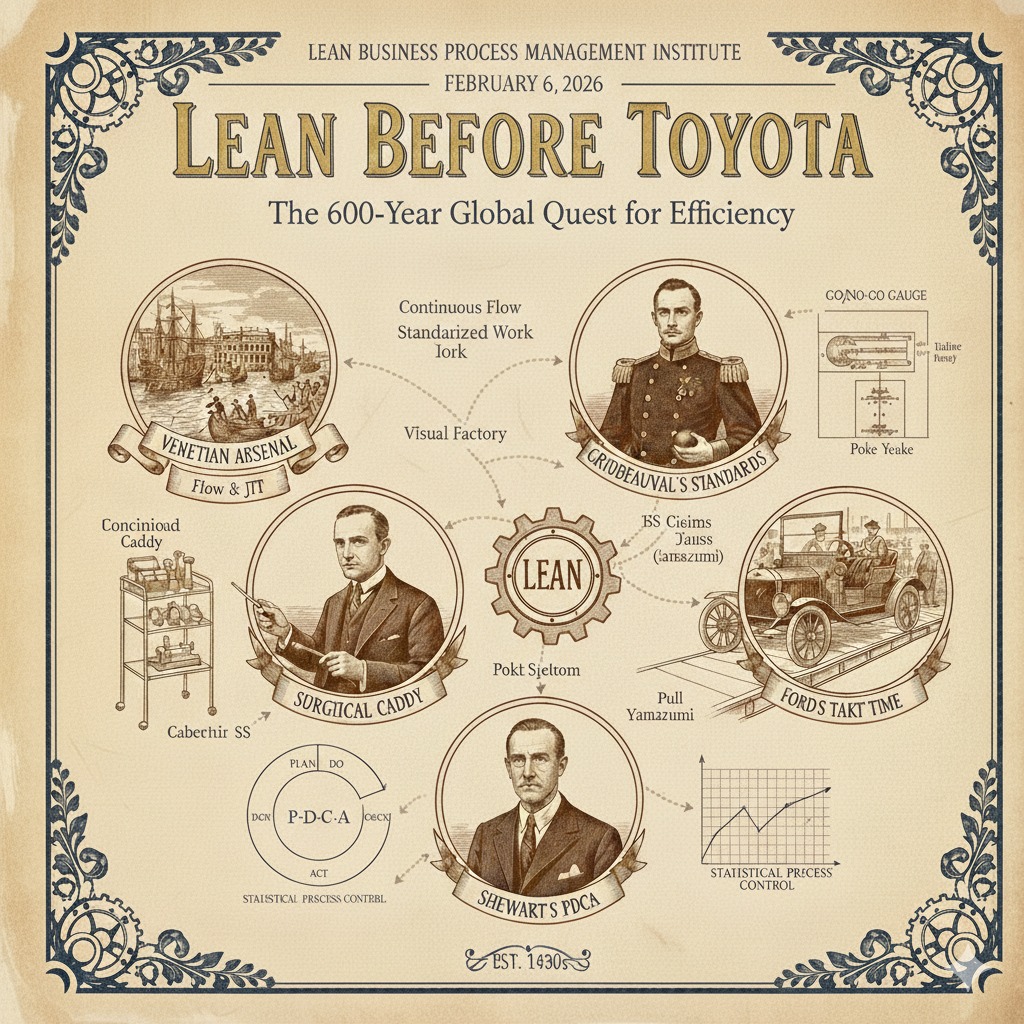
If you believe Lean manufacturing was born in 1950s Japan, you are missing 80% of the story.
While the Toyota Production System (TPS) famously codified the architecture of modern industry, the “Toyota Way” was not a sudden invention, it was the culmination of a 600-year global quest for perfection. From the strategic canals of Renaissance Venice to the high-stakes battlefields of Napoleonic France, the principles of Lean have always been more than a corporate strategy; they are a fundamental human instinct for survival through efficiency.
In this deep dive, Lean Master Black Belt and Sensei Sajith Abeyrathne explores the pivotal historical milestones that evolved into today’s Operational Excellence mantra. By looking back, we gain the clarity needed to lead the future of global operations.
Let’s pull back the curtain on the “secret” history of Lean:
- The Venetian “Flow” (1430s)
Modern Principles: Continuous Flow, Just-in-Time (JIT), and the Visual Factory
Imagine a world where a massive warship took months to construct in a single, stationary dry dock. For the Venetian Republic, this traditional craft-based method was a strategic liability. They required a fleet that could be deployed at a scale and speed their competitors couldn’t match.
Their solution was revolutionary: they stopped moving the workers and started moving the product. By floating hulls down a designated canal, they created a sequential chain of specialized stations, essentially the world’s first “Linear Production Cell.” As the ship passed, specialized teams added masts, oars, or rigging in a synchronized cadence.
This 15th-century maritime strategy is the direct ancestor of the modern Toyota assembly line. Just as Toyota moves a chassis along a conveyor belt at a predetermined pace, the Venetians used the canal to dictate the flow.
The Result: Venice achieved an output of one fully armed galley per day, a feat of industrial synchronization unmatched for four centuries. This was Just-in-Time in its primitive, most pure form: the right component, in the right quantity, at the precise moment of installation. By ensuring the material flow matched the “pace of the water,” the Venetian Arsenal became the world’s first Visual Factory, where the physical movement of the ship served as the ultimate status report for leadership.
- Napoleon’s Secret Weapon (1760s)
Modern Principles: Standardized Work, Interchangeable Parts, and Poke-Yoke
In the mid-18th century, Jean-Baptiste de Gribeauval, a French artillery officer and visionary engineer, identified a critical failure point in military logistics: a lack of uniformity. At the time, every cannon was a “custom build.” If a wheel or a screw shattered in the heat of battle, the entire weapon was rendered useless because no two components were identical. To the army, this wasn’t just a waste of resources, it was a fatal lack of agility.
To solve this, Gribeauval introduced a revolutionary system of technical specifications. He realized that for a process to be repeatable and reliable, it required absolute Standardization. To ensure this at the factory level, he developed “go/no-go” gauges physical templates that acted as the world’s first industrial Poke-Yoke (Error Proofing).
If a part did not fit perfectly through the gauge, it was immediately rejected at the source. This prevented “defects” from ever reaching the “customer”—in this case, the soldiers on the front lines.
The Result: By enforcing Standardized Work on a national scale, Gribeauval transformed the French artillery into a modular, high-velocity machine. This was the birth of Interchangeable Parts. It allowed for rapid, on-site battlefield repairs that other nations simply couldn’t replicate. In modern terms, Gribeauval shifted the focus from inspecting for quality to building quality into the process—a cornerstone of the Toyota Production System and a prerequisite for any world-class operation today.
- The Surgical Caddy (1910s)
Modern Principles: Motion Study, 5S (Set in Order), and Ergonomics
In the early 20th century, Frank Gilbreth—a pioneer of motion study—observed a critical inefficiency in the high-stakes environment of the operating theater. He noticed that surgeons spent a significant portion of their focus not on the patient, but on the frustration of searching for instruments. While a patient lay on the table, the surgeon’s flow was constantly interrupted by “motion waste” as they reached for or requested tools from an unorganized tray.
Gilbreth realized that in surgery, as in manufacturing, Muda (Waste) of motion can be fatal. He applied his rigorous scientific approach to develop the “Surgical Caddy.” This was not just a container, but a precisely engineered layout where every instrument had a designated “home,” placed in the exact sequence of the procedure.
This was the birth of 5S specifically Seiton (Set in Order) long before the term existed in a factory manual. By ensuring that the “right tool was in the right place at the right time,” Gilbreth allowed the surgeon to maintain a “fixed-eye” focus on the value-adding work: the surgery itself.
The Result: This systematic organization drastically reduced surgical time and physician fatigue. Gilbreth proved that workplace organization is not merely about “neatness”; it is a strategic discipline that eliminates cognitive load and physical waste. In modern Lean terms, he demonstrated that a stable and organized environment is the prerequisite for Standardized Work and high-precision execution.
- The Ford Paradox (1913)
Modern Principles: Takt Time, Line Balancing (Yamazumi), and the Pull System
By 1913, Henry Ford faced a paradox: the world’s demand for the Model T was skyrocketing, but his “stationary” assembly methods were at a breaking point. If one worker was faster than the next, inventory piled up; if one was slower, the entire factory sat idle. This “imbalance” was the enemy of throughput.
Borrowing concepts from the “disassembly” lines of meatpacking plants, Ford introduced the moving assembly line. But the true innovation was the introduction of “Takt Time” the rhythmic “heartbeat” of the factory. Ford calculated the exact pace at which the product needed to move to meet customer demand and synchronized every workstation to that beat. This required what we now call Yamazumi (Line Balancing), where tasks were meticulously redistributed so that every operator’s workload was equal and optimized.
The Result: Assembly time for a single chassis plummeted from 12.5 hours to just 93 minutes. Ford didn’t just create a car; he created a Pull system where the movement of the line “pulled” raw materials through the process at the speed of the consumer. This velocity transformed the economics of manufacturing, proving that when flow is balanced and synchronized, the cost of production drops while quality and volume soar.
- The Scientific Core (1920s)
Modern Principles: PDCA (Plan-Do-Check-Act) and Root Cause Analysis (RCA)
While Ford mastered the flow of parts, Walter Shewhart at Bell Labs was mastering the flow of information and quality. In an era where companies relied on “inspecting quality in” at the end of the line, Shewhart realized that this was a reactive and expensive failure. Every rejected part represented wasted labor, material, and time.
Shewhart introduced Statistical Process Control (SPC) and the iterative cycle of improvement. He shifted the focus from the product to the process. He argued that to achieve zero defects, one must scientifically understand the “Root Cause” of variation. This was the origin of the PDCA Cycle (Plan-Do-Check-Act), the engine of Continuous Improvement (Kaizen).
The Result: This scientific approach transformed quality from an afterthought into a deliberate design. By applying Root Cause Analysis (RCA), organizations could finally move away from “firefighting” and toward a state of predictable excellence. This methodology remains the brain of modern Business Process Management (BPM), ensuring that every improvement is verified by data and sustained by a standard.
Conclusion: Standing on the Shoulders of Giants
As we look back at these milestones, a profound truth emerges: Toyota’s genius was not the invention of these tools, but the masterful integration of them. Taiichi Ohno and Shigeo Shingo did not simply “find” Lean; they synthesized 600 years of human ingenuity into a singular, human-centric philosophy. They understood what many modern leaders miss: without a Standard, there can be no Kaizen (Improvement), and without a deep respect for the person doing the work, systems inevitably fail.
As we navigate the digital and AI-driven complexities of 2026, we are simply the latest stewards of this ancient quest for perfection. The tools may evolve from physical gauges to digital twins, but the principles remain immutable. To lead the future of operations, we must first master the “truest” things that have stood the test of time.
What is your Story?
Every organization, no matter its industry or scale, is currently living a story. It is often a story of hidden bottlenecks, untapped human potential, or the persistent “noise” of waste that masks true value.
As a Lean Master Black Belt with over 15 years of global implementation experience, I want to hear your story.
Whether you are an individual practitioner seeking to sharpen your expertise or a corporate leader ready to revolutionize your value stream, our experts at the Lean Business Process Management Institute are ready to collaborate with you.
We don’t just provide “tools”; we partner with you to develop tailored actions and precision solutions that deliver greater, improved, and sustainable results.
Contact us today to begin your next chapter:
- Email: Sajith.A@leanbpmi.com or Sharmila.S@leanbpmi.com
- WhatsApp: +94773455558
Lean Business Process Management Institute
About the Author:
Sajith Abeyrathne is a Lean Master Black Belt and Manufacturing Excellence Sensei with 15+ years of experience driving Operations and Continuous Improvement in global organizations. Trained in the heart of Japan’s manufacturing culture, he specializes in translating historical Lean DNA into modern world-class performance.
LinkedIn: www.linkedin.com/in/sajith-abeyrathne-65a7207a
1 Comment on Lean Before Toyota: The Global DNA of Modern Efficiency