

The Essence of Managing Change, Creativity and Innovation: A Practical View for Lean and Business Transformation Leaders
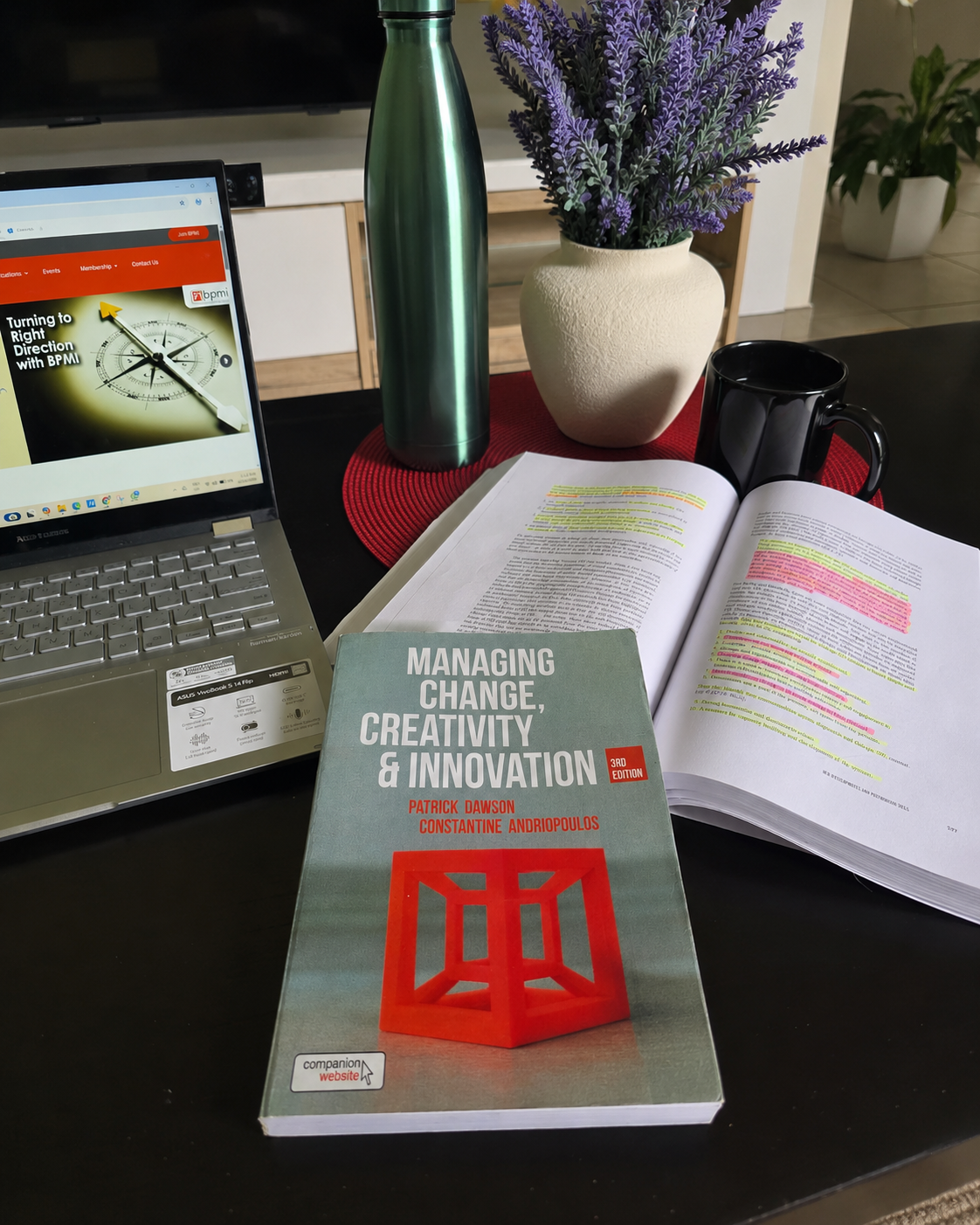
By Sajith Madhushan
Lean and Business Transformation Expert | Lean Master Black Belt | Lean BPMI Pvt Ltd
Why do so many change initiatives fail even when the idea is right?
Most organisations do not fail at change because they lack strategy, tools, consultants, technology or improvement ideas.
They fail because people do not clearly understand the purpose of change.
They fail because resistance is treated as negativity instead of useful information.
They fail because culture is spoken about in meetings but not changed in daily behaviour.
They fail because leaders communicate the change but do not practise the new way themselves.
They fail because creative ideas are collected but never converted into practical innovation.
They fail because projects are completed, but the new way of working is not sustained.
This is where change management becomes more than a theory.
In this article, I discuss the practical essence of Managing Change, Creativity and Innovation by Patrick Dawson and Constantine Andriopoulos, published by SAGE, and connect it with Lean thinking, Toyota philosophy and real business transformation experience.
More importantly, this article is not written only as a book summary. It is written for change agents, Lean practitioners, business leaders, continuous improvement professionals and transformation teams who want to understand the questions that really matter:
- Why do people resist change?
- How do we create a change story that people understand?
- How do we make culture visible and manageable?
- How do we move from creative ideas to implemented innovation?
- How do leaders make change part of daily work?
- How do we know whether change has created real business value?
Throughout this article, I also share practical tools that change agents can use, including the Change Story Canvas, Current-State Reality Walk, Stakeholder Sensemaking Map, Resistance Diagnosis, Creativity-to-Innovation Funnel, A3 Change Management, Pilot-Learn-Scale Method, Leadership Standard Work and Benefits Realisation Board.
Because successful change is not about pushing people harder.
It is about asking the right questions, understanding the real system, engaging people properly, creating disciplined learning, and building a better way of working that lasts.
Introduction: Why change, creativity and innovation must be understood together
Organisations today do not struggle because they lack ideas.
Most organisations already have enough improvement opportunities, enough operational problems to solve, enough customer pain points to address, and enough people who know what needs to be fixed.
The real challenge is different.
The real challenge is the ability to convert ideas into practical improvements, convert improvements into new ways of working, and sustain those new ways long enough to create measurable business value.
This is why the connection between change management, creativity and innovation is so important.
Some time ago, I read Managing Change, Creativity and Innovation by Patrick Dawson and Constantine Andriopoulos. Later, through my exposure to the Toyota Manufacturing System and Lean philosophy in Japan, and through many years of implementing Lean, continuous improvement and transformation initiatives across organisations, I started to see the practical value of this connection more clearly.
As a Lean Master Black Belt and business transformation practitioner, my experience has been across Sri Lanka, India, Vietnam, Haiti , Cambodia, Egypt, and now Australia. I have worked with many organisations where improvement was not just about applying tools. It was about changing mindsets, behaviours, leadership routines, systems, culture and daily management practices.
This article is my practical interpretation of the essence of Managing Change, Creativity and Innovation, connected with Lean thinking and real-world business transformation experience.
- Change is not a project. It is a living process.
One of the most important lessons in managing change is that change does not happen in a clean, straight line.
In many organisations, change is presented as a structured project:
Current state → future state → implementation → results
This looks good on a slide, but real organisational change is rarely that simple.
When we introduce a new process, a new structure, a Lean system, a digital dashboard, a new KPI, or a new way of managing work, we are not only changing the technical process.
We are changing how people think, behave, decide, communicate and respond to problems.
For example, implementing a Lean daily management system is not only about introducing a meeting board. The real change is deeper:
- Managers must start reviewing facts instead of assumptions.
- Supervisors must respond to abnormalities faster.
- Operators must feel safe to highlight problems.
- Teams must discuss root causes instead of blaming people.
- Leaders must follow up actions consistently.
- Performance must become visible, practical and actionable.
This is why many change initiatives fail. They implement the visible part but ignore the human and cultural part.
In Lean transformation, the tool is only one part of the change. The real transformation happens when the new behaviour becomes the normal way of working.
Practical questions change agents should ask
- What is really changing here?
- Are we changing only a process, or are we changing behaviour?
- Who will need to think, decide or act differently?
- What daily routines must change for this to be sustained?
- What could pull people back to the old way of working?
- How will we know the change is truly embedded?
- Creativity is not only for product designers. It belongs on the shop floor.
Many people think creativity belongs only to design teams, marketing departments or product development teams.
In my view, this is a very narrow understanding of creativity.
In Lean and continuous improvement, creativity happens every day.
- When an operator suggests a better way to arrange tools, that is creativity.
- When an Industrial Engineer improves line balancing to reduce waiting time, that is creativity.
- When a maintenance team develops a simple poka-yoke to prevent recurring defects, that is creativity.
- When a supervisor changes the way a team meeting is conducted to improve participation, that is creativity.
- When a trainer explains Lean concepts in a simple way that people can understand and apply, that is also creativity.
The practical difference between creativity and innovation is simple:
Creativity is the generation of useful ideas.
Innovation is the successful application of those ideas.
Change management is the process of helping people adopt and sustain the new way.
This distinction is very important.
An organisation may have many creative ideas but very little innovation. This happens when ideas are collected but not tested, implemented, measured or standardised.
Another organisation may implement new systems, but people do not adopt them properly. In that case, innovation does not become transformation.
A Lean organisation needs all three:
Creativity to generate better ideas.
Innovation to convert ideas into value.
Change management to make the new way sustainable.
Practical questions change agents should ask
- Are we creating space for people to suggest better ways of working?
- Are ideas coming only from management, or also from the people closest to the work?
- How do we select which ideas to test first?
- How do we convert ideas into pilots, results and standards?
- How do we recognise people who contribute practical improvement ideas?
- Resistance is not always a problem. Sometimes it is valuable information.
In many organisations, resistance to change is treated negatively.
People who question change are sometimes labelled as difficult, negative or not supportive.
However, experienced change agents understand that resistance can be a valuable source of information.
People may resist change because they do not understand the purpose.
- They may fear job loss.
- They may have experienced failed initiatives in the past.
- They may not trust leadership commitment.
- They may know practical problems that the project team has missed.
- They may feel that change is being forced on them without involvement.
This is where Lean’s principle of respect for people becomes extremely important.
A good change agent does not immediately fight resistance. A good change agent listens, observes, asks questions and understands what the resistance is really telling us.
For example, when people say:
“This will not work here.”
They may actually be saying:
“We have tried something similar before and leadership did not sustain it.”
When people say:
“We do not have time.”
They may be saying:
“Our current workload and priorities are already overloaded.”
When people say:
“Operators will not follow this.”
They may be highlighting a training, usability or ownership problem.
Therefore, resistance should not only be managed. It should be diagnosed.
The practical question is not simply:
“How do we overcome resistance?”
The better question is:
“What is this resistance teaching us about the quality of our change design?”
Practical questions change agents should ask
- What type of resistance are we seeing?
- Is the resistance emotional, practical, political, cultural or capability-related?
- What past experience may be influencing people’s reaction?
- Have people been properly involved in designing the change?
- Are people resisting the change itself, or the way it is being introduced?
- What can we learn from the resistance before pushing forward?
- Communication is not enough. People need to make sense of change.
Most change plans include communication. This usually means emails, presentations, posters, workshops and town hall meetings.
Communication is necessary, but communication alone is not enough.
People do not simply receive a message and automatically accept it. They interpret the message based on their own experience, fears, expectations and past organisational history.
For example, if management says:
“We are implementing Lean to improve productivity.”
Different people may hear different meanings.
One person may think:
“Good, we are going to solve problems.”
Another may think:
“This means job cuts.”
Another may think:
“This is another management campaign that will disappear in three months.”
This is why change agents must focus on sensemaking, not only communication.
We must help people understand what the change really means, why it matters, how it affects them, and how they will be supported.
Instead of saying only:
“We are implementing Lean to improve efficiency.”
A better message would be:
“We are using Lean to make work easier, reduce firefighting, improve flow, remove waste, solve recurring problems, and build stronger problem-solving capability. The purpose is not to blame people. The purpose is to improve the systems that affect people’s daily work.”
This type of communication is more human, more practical and more likely to create engagement.
Practical questions change agents should ask
- What message are people actually hearing?
- Could people misunderstand the purpose of the change?
- Are we explaining the change in business language only, or in practical workplace language?
- Have we explained what will change and what will not change?
- Have we clearly explained how people will be supported?
- Are leaders repeating the same message consistently?
- Culture decides whether creativity and innovation survive.
Organisational culture is often described in a complicated way.
I prefer a simple definition:
Culture is how people behave when nobody is forcing them.
An organisation may say it supports innovation, but punish people when experiments fail.
It may say safety comes first, but reward supervisors who achieve output by bypassing standards.
It may say it supports teamwork, but promote individual firefighting.
It may say Lean is important, but senior leaders do not attend improvement reviews.
It may say employees are empowered, but every small decision needs approval from multiple levels.
That is the real culture.
Creativity and innovation cannot survive in a fear-based culture. People will not share ideas if they believe they will be criticised. People will not highlight problems if they are blamed. Teams will not experiment if failure is punished.
A Lean culture is different.
- In a Lean culture, problems are made visible.
- People are encouraged to improve their own work.
- Leaders go to the gemba.
- Standards are respected.
- Data is used for learning, not only judgement.
- Mistakes are treated as opportunities to improve the system.
This does not mean there is no accountability. In fact, Lean requires strong accountability. But it must be accountability for learning, improvement and disciplined follow-up, not blame.
Practical questions change agents should ask
- What behaviours are currently rewarded?
- Are problems made visible or hidden?
- Do people feel safe to speak openly about issues?
- Do leaders respond to problems with curiosity or blame?
- Are improvement ideas acted on quickly?
- Does the culture support experimentation and learning?
- Are current KPIs encouraging the right behaviour?
- Power and politics are part of change.
One mistake technical experts often make is assuming that if the solution is logical, people will accept it.
But organisations are not only logical systems. They are also social and political systems.
Change can affect authority, influence, status, budgets, reporting lines, job security and decision-making power.
For example, a new Lean performance review system may expose problems that were previously hidden.
A new process may shift decision rights from one department to another.
A new digital system may reduce manual control that some people previously used as a source of influence.
Therefore, a change agent must understand stakeholders deeply.
- Who supports the change?
- Who is unsure?
- Who may lose influence?
- Who will gain responsibility?
- Who has informal power?
- Who can block the change quietly?
- Who needs to be involved early?
This does not mean playing politics in a negative way. It means understanding the real organisational environment and managing change intelligently.
Practical questions change agents should ask
- Who has formal authority over this change?
- Who has informal influence?
- Who may feel threatened by the change?
- Who needs to be involved early to reduce resistance?
- Who can become a champion?
- Who can silently block progress?
- What interests, concerns or power shifts must be managed?
Practical tools change agents can use
The value of a change management concept depends on whether it can be applied.
Below are practical tools that I believe change agents, Lean practitioners and transformation leaders can use.
Tool 1: Change Story Canvas
Before starting any major change, the change story must be clear.
A good change story answers:
- Why must we change?
- What will happen if we do not change?
- What exactly is changing?
- What is not changing?
- Who will be affected?
- How will people be supported?
- How will success be measured?
This prevents vague communication and helps leaders explain change consistently.
A strong change story should connect three areas:
- Business need
- Customer or operational need
- People impact
For example, a Lean transformation should not be explained only as a cost-saving programme. It should be explained as a way to improve flow, reduce waste, improve quality, develop people, and create sustainable business performance.
How to use it
Before launching the change, gather key leaders and representatives from affected teams. Ask them to answer the core change story questions in simple language. Then convert the answers into a clear and consistent message that can be used by all leaders.
Tool 2: Current-State Reality Walk
Change should never be designed only from a meeting room.
A current-state reality walk means going to the actual workplace, observing the actual process, speaking with the people who do the work, and understanding the real problems.
In Lean, this is the gemba approach.
During a reality walk, a change agent should observe:
- Where does work wait?
- Where do people search for information, tools or approvals?
- Where does rework happen?
- Where are decisions delayed?
- Where do systems not match actual work?
- Where are customers affected?
- Where are employees frustrated?
- Where are leaders disconnected from reality?
This gives practical evidence for change. It also builds trust because people see that the change is based on real workplace understanding.
How to use it
Go to the workplace with a learning mindset, not an auditing mindset. Observe the process, ask respectful questions, collect facts, and identify the gap between the official process and the real process.
Tool 3: Stakeholder Sensemaking Map
A stakeholder map should not only show names and departments. It should also show how people are likely to interpret the change.
For each stakeholder group, ask:
- What does this change mean to them?
- What are they worried about?
- What do they need to understand?
- What support do they need?
- Who do they trust?
- What previous experience may affect their reaction?
This helps the change agent design better engagement.
For example, senior leaders may need to see business benefits. Supervisors may need practical support for daily execution. Operators may need reassurance, training and involvement. Support functions may need role clarity.
Different groups need different messages and different types of support.
How to use it
List the stakeholder groups affected by the change. For each group, identify their likely concerns, expectations, influence level and support needs. Then design communication, training and engagement activities accordingly.
Tool 4: Resistance Diagnosis
Not all resistance is the same. Therefore, the response should not be the same.
Resistance may come from:
- Lack of understanding
- Lack of skill
- Fear
- Poor timing
- Workload pressure
- Loss of control
- Lack of trust
- Bad previous experience
- Poor system design
- Cultural habits
A practical change agent diagnoses the type of resistance before responding.
- If people do not understand, we explain.
- If people do not know how, we train and coach.
- If people are afraid, we listen and reassure.
- If the process design is weak, we redesign it.
- If leaders are not role-modelling, we address leadership behaviour.
This approach is far more effective than simply pushing harder.
How to use it
When resistance appears, do not immediately escalate or blame. Identify the source of resistance. Then match the response to the cause. This helps turn resistance into learning and better implementation.
Tool 5: Creativity-to-Innovation Funnel
Many organisations have suggestion systems, but not all suggestion systems create value.
A practical creativity-to-innovation funnel includes seven steps:
- Capture ideas.
- Screen ideas.
- Prioritise ideas.
- Pilot small.
- Measure results.
- Standardise successful improvements.
- Scale across teams or sites.
This is very similar to PDCA thinking.
- Plan the improvement.
- Do the test.
- Check the result.
- Act by standardising or adjusting.
The key is not only to collect ideas. The key is to convert useful ideas into implemented, measured and sustained improvements.
How to use it
Create a KAIZEN management system with a simple process for collecting ideas, reviewing them regularly, selecting high-value ideas, testing them quickly and standardising what works. Keep the funnel visible so people can see what is happening to their ideas. Appreciate good work, give recognition, and motivate for continuous improvement.
Tool 6: A3 Change Management
A3 thinking is one of the most powerful Lean methods for managing change.
A good A3 creates clarity on one page. It helps the team understand the problem, root causes, target condition, countermeasures and follow-up plan.
For change management, an A3 can include:
- Background
- Current condition
- Target condition
- Problem statement
- Root cause analysis
- Stakeholder impact
- Resistance risks
- Countermeasures
- Countermeasure analysis
- Implementation plan
- Success measures
- Follow-up review
- Lessons learned
A3 thinking prevents teams from jumping to solutions too quickly. It keeps change practical, visual and evidence-based.
How to use it
Use an A3 before launching the change. Review it with stakeholders. Update it as learning happens. Treat the A3 as a living thinking document, not a completed template.
Tool 7: Pilot, Learn and Scale
Large-scale implementation without learning is risky.
A better approach is:
- Start small.
- Test in one area.
- Learn from real users.
- Adjust the method.
- Build local champions.
- Standardise.
- Scale carefully.
This approach reduces risk and increases ownership.
Many successful Lean transformations start with model areas or pilot lines. These areas become learning laboratories. Once the method is proven, it can be adapted and expanded.
The purpose of a pilot is not to prove that the original idea was perfect. The purpose is to learn what must be improved before scaling.
How to use it
Select one pilot area where leadership support and learning conditions are strong. Test the change, collect feedback, measure results, improve the method and then expand step by step.
Tool 8: Leadership Standard Work for Change
Change fails when leaders announce it but do not change their own routines.
If leaders want a new way of working, they must create new leadership habits.
Leadership standard work may include:
- Daily gemba walks
- Daily or weekly performance reviews
- Problem-solving coaching
- Follow-up on improvement actions
- Recognition of improvement behaviour
- Escalation of barriers
- Monthly benefits review
When leaders consistently practise these routines, people believe the change is serious.
When leaders do not follow up, people quickly understand that the change is optional.
Sustainable change requires leadership discipline.
How to use it
Define the leadership routines required to support the change. Make them visible. Review whether leaders are practising them. Coach leaders to ask better questions and remove barriers instead of only checking results.
Tool 9: Innovation Culture Audit
Before expecting people to innovate, we must understand whether the culture supports innovation.
A simple innovation culture audit can assess:
- Are problems visible?
- Do employees share ideas?
- Are people afraid of making mistakes?
- Do leaders support experimentation?
- Are improvement ideas implemented quickly?
- Is cross-functional collaboration strong?
- Are customers considered in improvement work?
- Are standards updated after improvement?
- Are successful ideas recognised?
- Are failures used for learning?
This type of assessment helps identify cultural barriers before launching major change programmes.
How to use it
Ask leaders, supervisors and employees to score these areas honestly. Compare perceptions across levels. Use the gaps to identify where cultural change is needed before expecting innovation to grow.
Tool 10: Benefits Realisation Board
One of the biggest weaknesses in many change initiatives is that they measure activity instead of benefit.
They track training completed, meetings held, documents prepared and projects launched. But they do not always track whether the organisation actually improved.
A benefits realisation board should show:
- Expected benefit
- Baseline
- Target
- Current result
- Owner
- Evidence
- Required behaviour change
- Sustainability risk
- Next action
This changes the conversation from:
“Did we implement the project?”
to:
“Did the change create measurable and sustainable value?”
This is very important in Lean transformation because improvement must be connected to business outcomes.
How to use it
Create a visible board or dashboard for each major change initiative. Track not only completion status but actual benefits. Review it regularly with leaders and process owners until the new performance level is sustained.
Lessons from Toyota and Lean philosophy
My exposure to Toyota Manufacturing System and Lean philosophy strengthened my belief that sustainable change is created through disciplined daily practice.
Many people associate Toyota with tools such as Kanban, Andon, JIT, SMED, Heijunka, 5S and Standard Work. These tools are important, but they are not the full story.
The deeper strength of Toyota is its management philosophy.
Toyota builds improvement into daily work.
Problems are made visible.
People are developed to solve problems.
Leaders coach at the gemba.
Standards create the foundation for improvement.
Small improvements accumulate into strong competitive advantage.
This is where Lean, creativity, innovation and change management meet.
Lean provides the operating discipline.
Creativity provides better ideas.
Innovation turns ideas into practical value.
Change management helps people adopt and sustain the new way.
When these four elements work together, transformation becomes possible.
What this means for Lean Green Belts and Black Belts
In my work, training Lean Green Belts and Lean Black Belts through Lean BPMI, I strongly believe that Lean professionals must go beyond tools.
A Lean Green Belt should be able to identify waste, solve problems, use basic Lean tools, engage people and implement practical improvements.
A Lean Black Belt should be able to lead cross-functional change, manage resistance, influence stakeholders, analyse complex problems, coach others and connect improvement work with business strategy.
A Lean Master Black Belt should be able to build organisational capability. This means developing people, designing improvement systems, guiding transformation, coaching leaders and creating a culture of continuous improvement.
Lean training must therefore include not only technical methods, but also change leadership, creativity, innovation, communication, stakeholder management and benefits realisation.
The future of Lean is not only about knowing more tools. It is about building people who can lead sustainable transformation.
Final thoughts
The essence of Managing Change, Creativity and Innovation is highly relevant to every Lean practitioner, change agent and business transformation leader.
The practical message is clear:
Change is not only implementation.
Creativity is not only idea generation.
Innovation is not only launching something new.
Transformation happens when people, systems, leadership, culture and disciplined execution move together.
A weak change agent installs tools.
A strong change agent builds capability.
A weak change agent pushes templates.
A strong change agent creates understanding.
A weak change agent blames resistance.
A strong change agent learns from resistance.
A weak change agent celebrates implementation.
A strong change agent verifies sustained business value.
For me, the most important lesson is this:
Sustainable change happens when creativity is encouraged, innovation is disciplined, people are respected, leaders practise the new behaviours, and improvement is connected to real business outcomes.
That is the essence of practical change management.
That is also the essence of Lean transformation.